About The Author

DOUGLAS CASTLE: PROFESSIONAL PROFILE


914.462.2299 (Direct Telephone)

914.514.1673 (Facsimile)

douglascastle (Skype, By Appointment)

douglas.castle@yahoo.com (Email - Preferred)

douglas.castle@icloud.com (Email - Large Document Transfers, By Arrangement)


Douglas Castle is a senior level expert in all matters of high-level corporate negotiations, deal structure and finance, strategic planning, international business, major project management and all aspects of business communication. He speaks, consults and writes frequently about these subjects, as well as about key aspects of leadership, crisis management and the Human Condition. He has authored a great many articles on a very wide variety of subjects. Mr. Castle is currently a private consultant to young companies in several different countries.


Mr. Castle has been, and continues to be a seasoned and acclaimed advisor, director and trustee to emerging enterprises and growing companies worldwide, across a broad variety of industries on matters of organizational development, strategic planning, financing (both institutional equity and debt), international incorporations and negotiating of joint ventures, licenses of intellectual property, and mergers and acquisitions. Mr. Castle’s current passions are centered upon leveraging his wealth of experience in high-stakes corporate negotiations, deal structure, organizational engineering, strategic planning, business communications, social media marketing campaigns and financing to foster innovation and entrepreneurial growth and success in promising early-stage companies.


Mr. Castle’s professional resume has encompassed: international banking, asset-based financing, merchant banking (equity), factoring, purchase order financing, trade financing, leasing, sale/leaseback transactions, credit enhancement and surety bonding, transactional structuring (mergers, acquisitions, LBOs, ESOPs, management buy-outs, transnational and domestic co-ventures), real estate investment syndication, and the creation and monetization of unique investment instruments.


He has written and presented operating plans for international and offshore banks, finance companies, leasing companies, guarantee (bonding and other credit enhancements) companies to various financial institutions and government agencies and ministries; he has chartered a number of international commercial and economic development banks and reinsurance companies in multiple offshore and international jurisdictions -- these institutions had a combined aggregate capitalization at their operating outset of in excess of US$12,800,000,000.00.


During the past thirty five years, he has also incorporated close to one hundred IBCs (International Business Companies) and formed more than a dozen APTs (Asset Protection Trusts) in conjunction with domestic and international legal counsel across many business sectors. He has worked as a turnaround expert for troubled US and UK companies, and has renegotiated loan terms with banks, other creditors, bondholders and shareholders for these companies, both as pre-bankrupts, and as debtors-in-possession or trustees-in-possession.


Some of Mr. Castle’s prior engagements have included: Chairman of Global Edge International Consulting Associates, Inc.; Executive Director of Global Business Intel™, an unincorporated Division of Global Edge Technologies Group, LLC; Director and Senior Consultant of The Castle Consultancy; Managing Director and Member of Global Edge Technologies Group LLC; Acting Chairman and CEO of TNNWC Group, LLC; Senior Financial Analyst In Charge Of Special Projects for National Westminster Bank, plc; Adjunct Associate Professor in the Department of Banking, Finance and Investments at the Hofstra University School Of Business; Director of Capitol Guaranty Surety Company Inc.; Director of First Empire Capital Corporation and First Empire Autolease, Inc.; Intelligence Contractor for Kroll International Inc.; Interim CEO for AGP Group (publicly-traded, subsequently privately purchased); Member of the Board Of Directors, Triangle Group International, Inc. (publicly-traded, subsequently divided into several private concerns, each one a Management Buyout); and numerous others.


Mr. Castle received his B.S. in Economics from Stony Brook University (1976), with Omicron Delta Epsilon honors (as well as a New York State Regents Scholarship), and he received his MBA in Public Accounting from The Hofstra University Graduate School Of Business (with a graduate fellowship) in 1979.


Mr. Castle is a passionate and prolific speaker and writer about topics relating to Internationalism, futurism, leadership, negotiation, communication, and a variety of other non-financial topics.


You can obtain more information about Douglas Castle’s personal, educational and professional background by visiting his Linked In profile, which can be found by going to http://www.linkedin.com/in/douglascastle


Douglas Castle

914.462.2299 (Direct Telephone)

914.514.1673 (Facsimile)

douglascastle (Skype, By Appointment)

douglas.castle@yahoo.com (Email - Preferred)

douglas.castle@icloud.com (Email - Large Document Transfers, By Arrangement)


This document is Copyright © 2017 by Douglas Castle, with all rights reserved.

Sunday, November 26, 2017

Leadership: Delegate Or Die!


Leadership: Delegate Or Die
One Of the Most Important Responsibilities Of A Leader Is To Delegate Responsibility
By: Douglas Castle

To be a leader and to maintain a position of leadership, you must be a competent and efficient delegator. By the act of delegating, you are not reliquishing control – you are actually expanding the realm and scope of your control. The larger the responsibilities and the larger the organization, the more proficient you must be at delegation.

In the military, “delegation” is defined as the action by which a commander assigns part of his or her authority commensurate with the assigned task to a subordinate commander. While ultimate responsibility cannot be relinquished, delegation of authority carries with it the imposition of a measure of responsibility. The extent of the authority delegated must be clearly stated.
Your success at delegation will determine the strength and length of your reign as a leader and commander. The most significant insights and skills which are required in successful delegation are listed below. They are worth studying:

=> If you are obsessive-compulsive by your nature, do all that you can to rationally counterbalance this dangerous impediment to effective delegation. You cannot micromanage and be a leader. You cannot be the servant of your subordinates because you are insistent about things being done exactly as you would have them done;

=> You must constantly keep the big picture and the broader focus in mind. If you are a perfectionist and overly detail-oriented, you will never be able to attain your organizational objectives while mired in minutiae [this is a sophisticated alliteration -- wouldn't you agree?];

=> Understand all of your responsibilities, and itemize or componentize each of them. You'll find that each individual component can be delegated (as it must) to someone in your organization whom you can select. If the right individual is not among your inventory of Human Assets, then you must either replace some of your people, or your must acquire some new members with the requisite skill sets. The objective is to export as many of your responsibilities as possible, while retaining the central responsibility of organizational stewardship, oversight and goal attainment;

=> When you delegate responsibility for the accomplishment of a task or function, also remember to grant the requisite authority and to impose the necessary accountability upon the person to whom you've charged with the job. Responsibility without authority is a recipe for managerial impotence and non-performance. Responsibility without accountability is a recipe for waste, abuse and failure;

=> Since you, as a leader, are ultimately responsible for the successful and efficient attainment of your organization's most important goals, you must constantly monitor the performance of those to whom you've delegated, without being drawn in to correcting their mistakes yourself. Observe, measure, suggest, monitor and determine whether the subject task has been assigned to the right individual; sometimes a change may be warranted.

=> Where you observe leadership potential in some of those persons to whom you've delegated tasks, you may find it wise to increase their roster or responsibilities, but to also grant them greater authority to sub-delegate to others who are subordinate to them. Remember that the greatest leaders know how to identify and cultivate leadership within their organizations. Be aggressive and bold about identifying and leveraging the leadership talents of other leaders wihin your organization. Encourage leadership and acceptance of increased responsibility. Reward it and give it appropriate recognition. Empowering other leaders liberates you to be a greater leader yourself.

=> As you develop leaders and assign them to their respective specialty areas (not unlike fiefdoms within a kingdom), clearly identify where each one's territory begins and ends. Clearly define their responsibilities with minimal overlap. Keep your subordinate leaders separated from each other (unless you are present and orchestrating or conducting a meeting or hearing reports) – fiefdoms should not compete, but neither should their feudal lords unite, lest they undermine the king's leadership. In brief, don't permit your subordinates to take you over. Delegate, but do so without ever permitting your absolute command from being undermined. Keep your emerging leaders separated from each other, and even instill a competitive spirit amongst them to 'fight' for your approval. 

The Take-Away: To expand the scope of your control, power and productivity, you must learn to delegate. Also, another important skill (but not the subject of this article) is the recruitment and mentoring of talent for the accelerated expansion of your corporate or military kingdom. 

As always, thank you for reading me.

- Douglas Castle

Labels, Tags, Keywords, Categories And Search Terms For This Article:

Monday, November 20, 2017

Managing The Virtual Enterprise

Managing The Virtual Business Enterprise
Being A Virtual Virtuoso
Managing Employees And Contractors Over Space And Time
The Unique Interpersonal Skills Required Of A Team Leader Or Project Manager Who Works Virtually


An aerial view of a virtual employee, stock photo style, which employee who could easily win the intergalactic prize for the neatest, most stereotypical and technologically incongruous desk of all time. [There - I’ve actually said it and we all feel better!]


Introduction

With virtual enterprises being on the rise, the issue of how to direct and coordinate the efforts of a group of people working remotely is crucial. Certain management directives, as well as the deployment of certain technology will be essential to the success of the virtual enterprise. This article breaks this topic into two sections, one being “Communications Protocol” and the other being “Useful Technologies”. The bold assumptions here are that the enterprise at issue is completely virtual, that employees or contractors working from home offices each have a specific area of responsibility and corresponding accountability (and are fully aware of what is expected of them), and that it is your role, gentle reader, to manage their work efforts and their ultimate work product.

In the growing world of the virtual organization, the best natural or trained communicators and charismatic commanders will rise to the top as successes, whereas the more technically-oriented individuals taking the narrower view of business, i.e., those who manage processes and projects instead of managing people, will tend to lag behind in their ability to bring out the best in the employees and contractors as a group.

Communications Protocol

  1. Contact every employee or contractor at least once daily via telephone or Skype -- preferably via Skype due to its video feature, and simply inquire as to: A) what that individual is working on, B) does he or she require assistance or additional resources, C) whether or not he or she been in communication with any of the other team members, D) what his or her expectation is in terms of meeting his or her budget and performance deadlines, E) whether you might just have a look (either via email, screenshare or through collaboration tools) at what he or she has produced so far.

  1. Hold a weekly meeting of all employees and contractors in order to build the sensation of team, to allow for intelligence-sharing and brainstorming and to encourage open communications amongst all members of the group.

  1. Schedule meetings, as necessary, via telephone or Skype [Skype video is much better than mere telephone conversation because you have the additional dimension of body language to enhance the efficacy of interaction], with twosomes or other small groups of employees and contractors who may have dependent or overlapping responsibilities, or who may be at odds with each other for any number of reasons.

Communication should be frequent (short bursts), intensive and highly-focused. As the manager or project coordinator, you must also keep the entire team apprised of any changes in budgeted resources, expected timeframes, engagement scope, and the like. You must monitor their performance with great vigilance and you must foster a spirit of “team” and of “teammates”. You are the conductor of an orchestra with remote instrumentalists… and you are responsible not only for getting the best performance out of each virtuoso, but you must get the best performance out of the entire virtual orchestra, which requires providing frequent feedback and input.

Useful Technologies

Aside from the telephone and Skype, the following are all helpful collaboration, communication and cooperation tools which can be used by the manager to keep the virtual business tightly together and performing as a whole. Google has a suite of tools which are almost “made to order” for virtual teams needing to accomplish great and meaningful things.

GOOGLE DOCS - A great tool for sharing documents and for the cooperative authorship of documents such as reports, plans, etcetera. Certainly far more efficient than sending documents back and forth to groups of people as attachments to email correspondence. This is one of my favorites.

VIBER - A smartphone application which allows free international voice calling.

ALL OF THE OTHERS - A host of other contemporary (as of the date of this writing) tools is available to supplement the above. These are discussed in some detail in an article recently published by Time Doctor™. Just click on the link below for a wealth of information on these gizmos and gadgets:


Some Other Thoughts Regarding This Topic

  1. If your team is international, or if time zones may be an issue (even between New York and California), give very careful consideration to the times at which you contact individuals and arrange group meetings. For group meetings you might want to shift the weekly scheduled time (after giving very ample notice to all of your employees and contractors) to accommodate different people in different geographies.

  1. Use as many visual aids as possible to be clear and effective over time and distance.

  1. Be rapidly responsive when employees and contractors contact you; this might mean working an extended schedule to get the job done right.

  1. Don’t ever forget to offer praise and encouragement (and don’t be robotic - your team members will be more responsive to a Human than to a cheap science-fiction cyborg or automaton) -- these are part of sound management.

  1. As the manager of your virtual team, you are expected to A) know how to use each of the best collaboration tools, and B) to be ready, willing and able to remotely train your employees and contractors in the use of each of them. Waxing philosophical for a brief moment, in this life you must be a great student and a great teacher in order to truly be successful.

Lastly, remember that while a modicum of patience is critical in managing people, too much patience and empathy can make for poor leadership. And you can be certain that managing a virtual team requires emotional intelligence and people skills well beyond those required to manage a real-time, physically-grounded enterprise.

Thank you, as always, for reading me. - Douglas Castle

Monday, November 13, 2017

4IR: The Fourth Industrial Revolution Is Here.


4IR: The Fourth Industrial Revolution Is Here
What Is It?
How Does One Prepare For It?
Are You Prepared For It?


Is it just me, or does this remind you just a bit of the movie “ET”?


The Fourth Industrial Revolution, or 4IR (it has become very hip to speak in alphanumeric acronyms, although this is quite exclusionist, and creates communication problems between heterogeneous groups engaged in either conversation or combat…), is the fourth major industrial era since the initial Industrial Revolution of the 18th century.

The Fourth Industrial Revolution, which is upon us right now (OMG!) has been described by some self-professed and oftimes pompous multidisciplinary pundits as a “range of new technologies that are fusing the physical, digital and biological worlds, and impacting all disciplines, economies and industries.” Klaus Schwab, noteworthy Founder of the World Economic Forum, has associated it with the "second machine age" in terms of the effects of digitization and AI (“artificial intelligence”) on the economy, but added a broader role for advances in biological technologies.

Schwab sees as part of this revolution "emerging technology breakthroughs" in fields such as artificial intelligence, robotics, the Internet of Things (IoT), autonomous vehicles (accident-free driving, until driving automation systems are hacked, after which I can sense a bumper car jamboree!), 3D printing, quantum computing and nanotechnology. Schwab, in all of his wisdom, has neglected to include machine learning (different from AI) and stem cell technologies in his assessment and definition.

How do we prepare for this wave that is washing over us? I believe that the answer is in doing as much research and reading on every top news topic (the serious ones, and not the ones about celebrity misconduct or “discoveries” from the front pages of tabloids) that emerges. Education has now become our primary survival tool. It is a manual and arduous process (which is oddly ironic, especially in this age of automation and instantaneity), but it is what is required.

Lamentably, this revolution is going to open a wider gap between the few super-wealthy elites and the ever-growing ranks of the working poor. This situation, if it continues could actually foment a Fifth Industrial Revolution (i.e., 5IR) which could either lead to the end of history (in the most adverse sense of the expression), or to a frightening new form of total slavery, such as the world has never witnessed. I hope that I am proven wrong.

Thank you, as always, for reading me.   - Douglas

Tuesday, November 7, 2017

Expectation Management: Crucial To Your Survival!

Expectation Management: Crucial To Your Survival

*If You Fail To Successfully Manage Expectations, You’ll Lose Your Business, Your Career And Your Friends
*Expectation Management Requires Clear And Frequent Communication
*It’s Very Difficult To Restore Trust, Once It Has Been Violated

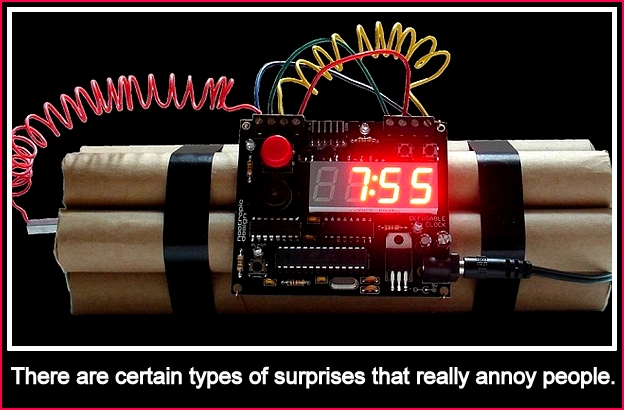
BOMB ALARM.jpg

Most people don’t really enjoy most types of surprises. We live, and plan our lives, upon certain expectations; they provide a modicum of stability in a changing, too often chaotic world. When these expectations turn out to fall short of the ultimate reality we experience, we get angry. That is, for better or for worse, Human Nature.

We are conflicted and caught between two cliches: One of them is “Always under-promise and over-deliver”. The other is (and I’m laughing while I write this) “It’s far better to beg forgiveness than to ask permission”. The first one is applicable in all but a few unusual and desperate circumstances.

In expectation management, the idea is to set realistic, achievable goals and to communicate through the entire step-by-step process with your customer or client. If a process step is going more slowly than expected, get in front of it and advise your customer or client of the anticipated delay -- and explain the reasons for it. Be candid - people will appreciate and respect you for it; you might not make them happy, but they won’t come running after you with a blowgun and a quiver of poison darts, either.

When you are going to have a prospect sign a contract, never, ever, just send it to him ‘cold’. He’s liable to misunderstand it, or suffer ‘sticker shock’ and reject your offer (no matter how generous it might be) because it was sprung upon him to suddenly. The general rule here is to discuss beforehand with the customer or client what he can expect to see in the contract -- this gives you an opportunity to break it all down into small pieces and explain it thoroughly. It’s easier to digest small pieces than to eat the whole moose in one go. And if your customer or client raises objections to certain parts, you can deal with each one of them conversationally, instead of in the heat of your customer’s or client’s consternation and anger.

In particular, people are intimidated by what they see in writing, but not as much by what they hear conversationally… especially if there is casual, spontaneous give and take. Disarm the written bomb (people view written agreements as if they were grand jury subpoenas, or draft notices) with conversation to satisfy expectation. The recipients of these mighty missives expect trickery and shenanigans. Their fears must be allayed in advance.

Nothing is better than speaking with a customer or client to whom you’ve just handed a written agreement and saying, “Here it is, exactly as we had discussed. Would you like to go over it again briefly, paragraph by paragraph?”

If you’ve done a masterful preparatory job, the customer or client might just say, “No. Let’s just sign this thing. I’m tired of talking about it. Let’s do it.”

As always, thank you for reading me. - Douglas


Friday, November 3, 2017

Remote Working: Here To Stay!


REMOTE WORKING: HERE TO STAY
“Telecommutation is still sweeping the nation.” - Douglas Castle
 REMOTE - Douglas Castle.jpg

I recently noted a discussion on LinkedIn regarding IBM’s move to minimize remote working and to call its employees, from near and far, back to the office. This was what I read:

Why remote working will die.

IBM's recent move to call its remote workers back into the office has thrown into question whether telecommuting is more or less productive than being at one's desk. Studies on the topic have come out mixed but the Atlantic argues that with fast-paced technological change, and the complex problems that arise from it, workers may increasingly be chained to their desks • What are your thoughts on working from home? Join the conversation.
---------------

Nope. It’ll survive and thrive. Sorry Folks.

I beg to differ. The following factors will virtually [no pun intended here] ensure the survival (and even the expansion!) of remote working in the industrialized nations, and in particular, the United States, from which I am currently (remotely, via telecommute) working:

  1. The rise and growth of the Gig Economy. Many displaced employees and solopreneurs have become members of the ever-expanding Gig Economy, where an individual sells a specialized service (usually at a relatively low price per unit of service) via internet to clients (usually other individuals, entrepreneurs or small businesses). Platforms such as UpWork and Fiverr provide a medium for matching up providers and demanders of ‘job work’ of all different types.

  1. The increase in the retention of independent contractors by employers, in lieu of traditional full-time hiring. Employers are trying to limit their exposure and expense associated with taxes and providing insurance benefits for regular employees. This has led to an increase in the hiring of independent contractors and more courageous forays into the Gig Economy for employers. It has also increased outsourcing and offshoring activity.

  1. The Globalization of business - the prevalence of international business relationships even amongst small to medium-sized businesses. An increasing percentage of business communications are taking place via Skype, WhatsApp, Viber, FaceTime and other remote media. And business is being conducted at all hours of the night and morning for many firms and individuals.

  1. Time efficiencies. Commutation to a physical location may cost several otherwise productive hours out of the day. Telecommuting (i.e., remote working) eliminates that wasted time and makes it available for productive use, or for valuable time with families in an overworked culture.

  1. Technological innovations. Holographic projections, anyone? As technology improves and provides ever-better means of communicating over distances, remote work will become more efficient and a great deal more effective.

While it is indeed true that there are greater opportunities for synergy, breakthroughs, interpersonal connection (i.e., body language, nonverbal communication) and spontaneity when people work together on-site, the factors in favor of remote working greatly outweigh the factors weighing against it. And you can expect the trend and tendency to continue.

And here is an interesting Google return for the search on Remote Working Statistics 2017. [CLICK ME]

Thank you, as always, for reading me. - Douglas

Wednesday, October 25, 2017

Cybersecurity Update: Dangerous Technological Dependencies


CYBER ATTACK [1] - Douglas E. Castle.jpg


UPDATE: CYBER THREATS AND CYBERSECURITY
“Into the breach we must go!” - Douglas Castle
“This ain’t no party/ This ain’t no disco…” - from Life During Wartime by The Talking Heads

In terms of data breaches, identity theft, computer-originated financial fraud, ransomware, viruses, trojan horses and backdoor invasions (and commandeering of systems), I believe that no one and no organization is truly safe or exempt. No matter how much we, as the public, hear about breaches and their purported impact, there is a whole alternate universe of companies who have experienced breaches that they are not forthcoming enough to disclose.

The more dependent we as a society become on computers, devices, the cloud and other dangerous dependencies (I’m a bit of a Luddite and a technophobe myself), the more we are at risk of loss. It seems that there is a definite tradeoff here: convenience versus security. And more and more, the default choice is convenience as technology becomes further ingrained into our collective psyche and into our day-to-day operations in virtually every aspect of our existence.

Short of eliminating the use of these magical methodologies, we should take steps to temper our activities with a modicum of caution. Here are a few suggestions, coming from my alternate life as a Global Futurist . Some are practical, while others involve an element of behavior modification and wishful thinking:

  1. Print out and store documents and critical information in hard copy form to the greatest extent possible. If your drive becomes wiped or the information becomes infected or compromised, you’ll have your important records secure;

  1. Increase your percentage of Human-To-Human communications and transactions. Personalize, Recognize and Humanize;

  1. For computer and data security, use the most effective anti-virus, anti-malware, anti-hacker attempt (yep. That’s a real feature) software, downloaded or otherwise obtained from a highly-trusted source;

  1. Don’t share your screen or documents (i.e., Google Docs, etc.) with anyone, if you can avoid it;

  1. Keep passcodes and other access information off of your computer, and on a separate manual record. Keep that record well-hidden, but accessible to you. Keep it under lock and key, but don’t bother using a computer-activated lock -- that would defeat the whole purpose;

I’m also a big fan of multiple biometric device security in combination with ever-changing, encrypted passwords or “sayings of the day”-type passwords to make direct access to your machine or device extremely difficult in a full frontal attempt to breach your system security. As you’d guess, I’m highly paranoid with respect to the cloud -- I believe that what goes up, will come down -- but it might come down to someone else’s system. I have sweating, shaking nightmares about the cloud being hacked, or satellites being hacked, or public utilities being hacked…

The problem of vulnerability grows as we enter, head first, into the Era Of Complacent And Complete CyberDomination, where the inventions which were supposed to make our lives simpler and safer are now rapidly and quietly becoming our lives' masters. Laziness makes for a lack of vigilance. 


Let’s truly make November “Computer Security Month”. Now let’s look at what the pundits have to say, for a full-blown Halloween scare-a-thon.

Oh, and thank you, as always, for reading me. - Douglas

----------------------------------------------------------------------------------------------------------------------------------

Let’s start with some frightening statistics and projections from 2017 to up to five years hence. This information was excerpted from CSO Online...

“These top level numbers summarize the cybersecurity industry over the past year and indicate what's in store for the next five years.

1. Cyber crime damage costs to hit $6 trillion annually by 2021. It all begins and ends with cyber crime. Without it, there's nothing to cyber-defend. The cybersecurity community and major media have largely concurred on the prediction that cyber crime damages will cost the world $6 trillion annually by 2021, up from $3 trillion just a year ago. This represents the greatest transfer of economic wealth in history, risks the incentives for innovation and investment, and will be more profitable than the global trade of all major illegal drugs combined.

2. Cybersecurity spending to exceed $1 trillion from 2017 to 2021. The rising tide of cyber crime has pushed information security (a subset of cybersecurity) spending to more than $86.4 billion in 2017, according to Gartner. That doesn't include an accounting of Internet of Things (IoT), Industrial IoT, and Industrial Control Systems (ICS) security, automotive security, and other cybersecurity categories. Global spending on cybersecurity products and services are predicted to exceed $1 trillion over the next five years, from 2017 to 2021.

3. Cyber crime will more than triple the number of unfilled cybersecurity jobs, which is predicted to reach 3.5 million by 2021. Every IT position is also a cybersecurity position now. Every IT worker, every technology worker, needs to be involved with protecting and defending apps, data, devices, infrastructure and people. The cybersecurity workforce shortage is even worse than what the jobs numbers suggest. As a result, the cybersecurity unemployment rate has dropped to zero percent.

4. Human attack surface to reach 6 billion people by 2022. As the world goes digital, humans have moved ahead of machines as the top target for cyber criminals. There are 3.8 billion internet users in 2017 (51 percent of the world’s population of 7 billion), up from 2 billion in 2015. Cybersecurity Ventures predicts there will be 6 billion internet users by 2022 (75 percent of the projected world population of 8 billion) — and more than 7.5 billion internet users by 2030 (90 percent of the projected world population of 8.5 million, 6 years of age and older). The hackers smell blood now, not silicon.

5. Global ransomware damage costs are predicted to exceed $5 billion in 2017. That's up from $325 million in 2015—a 15X increase in two years, and expected to worsen. Ransomware attacks on healthcare organizations—the No. 1 cyber-attacked industry—will quadruple by 2020. Cybersecurity Ventures predicts that a business will fall victim to a ransomware attack every 14 seconds by 2019.
What does it all mean? In 2015, Ginni Rometty, IBM's chairman, president and CEO, said, "Cyber crime is the greatest threat to every company in the world."

And she was right. During the next five years, cybercrime might become the greatest threat to every person, place and thing in the world.”

-----------------------------------------------------------------------------------------------------------------------------------

October 13, 2017 - Excerpted From American Express OPEN FORUM


While the annual campaign is designed to raise awareness about cybersecurity breaches, as a business owner you're probably well aware of the growing threat.

The mounting number of company computer and data system breaches illustrates that it's no longer a question of if your company's sensitive data will be hacked, but when. Data analytics researcher Juniper Research predicts that data breach costs will reach $2.1 trillion throughout the world by 2019.

“It's important to realize that your company is at risk, which makes vigilance critical," says Gary S. Miliefsky, executive producer of Cyber Defense Magazine. “Many owners of small to medium-sized businesses don't think they're targets of hackers or cyber crime, but the fact is that most breaches are smaller now. To stay under the radar of the FBI and Secret Service, cyber criminals steal a small number of records, monetize those records and then hit again."

“This 'Wild West' phase of learning to anticipate and work against cyber threats goes deeper than surviving a breach and picking up the pieces afterwards," says Rob Arnold, founder and CEO of the cyber risk management company Threat Sketch and author of Cybersecurity: A Business Solution
.
“History is repeating itself," Arnold continues. “The future will play out just like it has with the advent of the internet. Businesses that embraced technology at a strategic level left their brick-and-mortar peers in the dust. In the same respect, those companies that learn to effectively manage cybersecurity threats will be the ones that are still in business 25 years from now."

New Cybersecurity Features

In order to thrive amidst the perpetual threat of cyberattacks, it helps to familiarize yourself with the latest arsenal of cybersecurity prevention tools available. Consider possibly incorporating the following new innovations into your company:

Automatic Classification of Cybersecurity Threats

“The problem in cybersecurity today is not a lack of tools," says Avi Chesla, CEO of the cybersecurity company empow
. “The question is how to 'read' the huge amount of data these tools generate and to understand the potential impact, such as a malicious attacker's intent."
   
A hack often starts with a spear-phishing attack where an employee clicks a link or opens an attachment in an email that appears to come from someone they trust.
—Gary S. Miliefsky, executive producer, Cyber Defense Magazine
           
According to Chesla, there are new cybersecurity capabilities that use Natural Language Processing algorithms. These collect and interpret system information and classify that information by intent. Knowing intent helps companies proactively respond to advanced threats.

Intelligent Cyber Threat Hunting

“With system breaches becoming more common, it's more important than ever for cybersecurity systems to have the capability to hunt and locate compromised hosts within systems," says Chesla.
                               
“New intelligent hunters include a technology that can identify host-related anomaly behavior, collect and analyze evidence," he continues, "such as unexpected processes and applications that run on the host, and create new IOC  [indicator of compromise] signatures accordingly." Detected IOC signatures indicate the presence of a security breach, such as malware. They are used to create new IOC signature files that are uploaded to scan systems in order to detect additional threats.

New Methods of Handling Vulnerable Data

“One of the biggest revolutions in cybersecurity is the idea that companies can attain the verified data they need without having to hold or manage personally identifiable information (PII) in one place," says David Thomas, CEO of Evident, a company that offers an Application Programming Interface that eliminates the need to collect, hold and protect personal data.

“Traditionally, any data that a business receives from a customer or employee is held in one potentially vulnerable database," says Thomas. “This means that if/when a breach occurs, hackers can get everything they want in one fell swoop. Companies are getting smarter about not only clarifying the data they need to ensure safety and security, but also how they need to handle that data to mitigate risk and liability."

The Use of Behavioral Biometrics

Ensuring identity is a common practice in cybersecurity protocol. Behavioral biometrics is the newest addition to this practice.

“Behavioral biometrics identifies people by how they do what they do, rather than by what they are (e.g., fingerprint, face), what they know (e.g. secret question, password) or what they have (e.g. token, SMS one-time code)," says Frances Zelazny, Vice President of BioCatch, a cybersecurity company offering behavioral biometrics to banks and other businesses.

----------------------------------------------------------------------------------------------------------------------------------

Labels, Tags And Keywords For This Article: cybersecurity, data, breach, biometric, security, hacking, malware, viruses, computers, dependencies, planning, systems, passwords, safety, humanizing, personalizing, cloud, protection, Equifax, Douglas Castle